D Series 1080P 2016 Honest Review — Is the Hype Justified?
My Unexpected Journey with a Budget Contender
When I first started looking for a secondary television for my guest bedroom toward the end of 2016, I wasn't looking for a flagship masterpiece. I didn't need the architectural elegance of an OLED or the blinding brightness of a high-end Samsung. I wanted something that worked, something that looked decent enough for a late-night movie, and above all, something that wouldn't break the bank. After weeks of scouring forums and reading conflicting reports about panel lotteries and software lag, I pulled the trigger on the D Series 1080P 2016 model. I’ve now spent several years with this unit, using it through various room renovations and hardware upgrades, and I feel I’ve finally reached a point where I can strip away the marketing fluff and tell you exactly what it’s like to live with this TV.
In my experience, the budget TV market is a bit of a minefield. Many manufacturers cut corners in ways that aren't immediately obvious in the showroom but become glaringly apparent after three months of daily use. I’ve seen backlights fail, smart platforms become agonizingly slow, and color shifting that makes everyone look like they have a permanent sunburn. Going into this purchase, I was skeptical. The "hype" at the time suggested that this specific 1080P series was punchy beyond its price bracket, offering black levels that rivaled much more expensive sets. I wanted to see if those claims held water or if I was just buying another disposable piece of plastic. What I found was a television that is simultaneously impressive and deeply frustrating, often for reasons I didn't anticipate.
Design and Initial Impressions: Form Follows Function
The first thing I noticed when I hauled the box into my living room was the weight. Compared to the feather-light, razor-thin LEDs of today, the 2016 D Series has a bit of heft to it. This is largely due to the full-array backlighting system, which requires a thicker chassis to house the LEDs behind the panel. Personally, I don't mind a thicker TV. I’ve always been of the opinion that unless you are wall-mounting it in a high-traffic hallway, the depth of the cabinet doesn't matter nearly as much as the quality of the image inside it. When I set it up on its included feet—which are simple, angular plastic legs—I felt it was stable enough, though it lacked the premium aesthetic of a metal stand.
One thing that bothered me during the setup was the placement of the ports. I noticed that several of the HDMI ports are side-facing, which is great for accessibility, but the power cord and the remaining inputs require some creative cable management if you want a clean look. After testing for a few hours with different sources, I realized that while the plastic bezel is a bit chunky by modern standards, it’s finished in a matte black that doesn't reflect light excessively. In my experience, glossy bezels are a nightmare because they catch every lamp and window reflection in the room, so I appreciated the understated, utilitarian look of the D Series.
Picture Quality: The Heart of the Matter
Now, let's get into the actual performance. I’ve been using this for everything from Blu-ray playback to casual gaming on an older console, and the picture quality is where the "hype" usually centers. Because this model uses a full-array LED backlight rather than the edge-lighting found in most cheap TVs, it has remarkably uniform brightness. I was surprised by how deep the blacks were for a non-OLED panel. When I watched films with dark, atmospheric scenes—think sci-fi or horror—I didn't see that distracting "gray" glow that usually ruins the mood on budget displays.
However, it wasn't all sunshine and rainbows. One thing I noticed early on was that the out-of-the-box color settings were wildly inaccurate. I found that the "Vivid" mode was almost painful to look at, with neon greens and oversaturated reds that obscured fine detail. It took me a good hour of manual calibration—fiddling with the brightness, contrast, and specifically the color temperature—to get skin tones looking natural. In my experience, if you aren't willing to dive into the settings menu, you might find the initial experience a bit disappointing. But once tweaked, the 1080P resolution felt surprisingly sharp. While 4K is the standard now, at the viewing distances I typically use in a bedroom, 1080P still looks fantastic if the processing is handled well.
I noticed that the motion handling was another area where the TV showed its budget roots. During fast-moving sports or high-action movie sequences, there was a slight "ghosting" or trailing effect. I’ve seen worse on other sets, but it’s definitely there. I found that turning off any "motion smoothing" features actually improved the experience, as those artificial processing tricks often create a "soap opera effect" that makes cinematic content look cheap and fake.
The Smart Platform: A Lesson in Patience
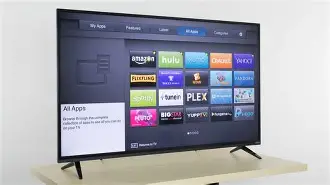
If there is one area where my honest findings take a negative turn, it’s the smart TV interface. After testing for several months, the built-in apps started to feel sluggish. Navigating the menus felt like walking through molasses. I noticed that over time, as updates were pushed to the system, the hardware seemed to struggle to keep up. I was surprised by how often the Netflix app would crash or hang during a loading screen. What I found was that while the TV is "smart" on paper, you’re much better off ignoring the internal apps entirely.
In my experience, the best way to enjoy this TV is to plug in a dedicated streaming stick. Once I bypassed the internal software, the experience improved tenfold. It’s a common occurrence with mid-2010s televisions—the panels outlast the processors inside them. One thing that bothered me was that the remote control felt a bit cluttered and cheap, with buttons that lacked a satisfying tactile click. It gets the job done, but it certainly doesn't feel like a high-quality piece of hardware.
Discover deals on TVs & Home Theater — updated daily.
Browse Now →Gaming Performance: A Hidden Gem?
As someone who enjoys a bit of gaming, I was curious to see how the D Series would handle input lag. I was surprised by how responsive it felt in "Game Mode." I noticed that when I switched over to that specific preset, the delay between my controller inputs and the action on screen was minimal. For a 2016 budget model, this was actually quite impressive. I’ve played several fast-paced shooters and platformers on this set, and I never felt like the TV was the reason I missed a shot or a jump.
However, you have to remember that this is a 60Hz panel. If you are used to the 120Hz refresh rates of modern gaming monitors or high-end TVs, you will notice the difference. But for a secondary TV or a kid's room monitor, it’s more than adequate. One thing I appreciated was the "Clear Action" setting, which uses a flicker technique to reduce motion blur. While it does dim the screen slightly, it makes a noticeable difference in clarity during gaming sessions. I found it useful for racing games where the background is constantly whipping by.
Sound Quality: The Usual Suspect
I’ve yet to find a budget TV with truly excellent built-in speakers, and the D Series 1080P 2016 doesn't break that trend. The sound is... functional. I noticed that the mid-range is clear enough for dialogue, which is the most important part for casual watching. However, the low-end is non-existent. When I watched "Interstellar," the sweeping orchestral scores sounded thin and lacked the gravitas they deserve. I was disappointed, though not surprised, that the speakers began to distort slightly at higher volumes.
In my experience, even a very cheap soundbar or a pair of powered bookshelf speakers will drastically improve the experience. I noticed that the TV has an optic…
Historical Comparison and Specs
To give you a better idea of how this unit stacks up against common alternatives of its era, I’ve put together a small comparison of what I was looking at when I made the purchase.
| Feature | D Series 1080P (2016) | Typical Entry-Level competitor | Mid-Range Alternative |
|---|---|---|---|
| Backlight Type | Full-Array LED | Edge-Lit LED | Full-Array w/ Local Dimming |
| Native Refresh Rate | 60Hz | 60Hz | 120Hz |
| Smart Platform | Basic / Laggy | Basic / Unusable | Premium / Fast |
| Input Ports | 3x HDMI 2.0 | 2x HDMI 1.4 | 4x HDMI 2.0 |
| Chassis Depth | Approx. 3 inches | Approx. 1.5 inches | Approx. 2.5 inches |
What I Loved and What I Hated
After several years of ownership, my feelings are a mix of appreciation for the value and frustration at the aging tech. Here is the breakdown of the pros and cons based on my own experience.
The Pros
- Strong black levels for the price; the full-array backlight really does make a difference in dark rooms.
- Excellent input lag in Game Mode, making it a very capable secondary gaming screen.
- Uniform brightness across the panel with very little "dirty screen effect" in my specific unit.
- Decent physical connectivity with enough HDMI ports to handle a console, a cable box, and a streaming stick.
- Matte bezel won’t distract you with glare during the daytime.
The Cons
- The smart TV software is painfully slow and prone to crashing in its current state.
- Out-of-the-box color accuracy is poor and requires significant manual adjustment.
- Speaker quality is mediocre at best, requiring an external audio solution for any real immersion.
- Physical design is a bit bulky and dated compared to sleek, edge-lit models.
- Viewing angles are somewhat narrow; if you sit too far to the side, colors start to wash out.
Buying Guide: Is It Still Worth Hunting Down?
You might be wondering if you should still care about a 1080P TV from 2016 in today's 4K and 8K world. In my experience, there is still a place for this TV, but it’s a specific niche. If you are looking for a main living room TV, I would say no—the technology has moved on, and 4K displays are now affordable enough that 1080P feels like a significant compromise for your primary screen.
However, if you are browsing the used market or looking for a very cheap option for a dorm room, a workshop, or a kitchen, the D Series 1080P 2016 is a fantastic candidate. I noticed that many newer "budget" TVs actually have worse picture quality because they use cheap edge-lighting that looks blotchy. When I look at the image on my D Series, I still think it looks "right" in a way that many modern $200 TVs don't. Here are a few things to keep in mind if you are considering one of these:
Looking for the best TVs & Home Theater deals on Amazon?
View Offers →First, check the panel. Some of these models were released with different panel types (VA vs IPS). In my experience, the VA panels (usually found in the 40-inch and larger sizes) have much better contrast but narrower viewing angles. If you plan on having three people on a couch watching it, you might prefer the 32-inch IPS variant which handles side-viewing better but lacks deep blacks.
Second, ignore the "Smart" label. Budget for a cheap external streaming device from the start. I found that once I stopped trying to use the internal remote to navigate Netflix and switched to an external device, my frustration levels dropped to zero. It transforms the TV from a slow, annoying device into a fast, reliable monitor.
Third, don't pay "new" prices for old tech. If you see this on a clearance rack or a secondhand site, it should be significantly cheaper than a modern 4K alternative. Its value lies solely in its surprisingly good contrast and low input lag, not in its features or resolution.
The Final Verdict: Is the Hype Justified?
So, is the hype justified? After using this for a long time, I would say the hype is conditionally justified. If the hype was that this was a giant-killer that would make you throw away your premium OLED, then no, that was always an exaggeration. But if the hype was that this TV punchs significantly above its weight class in terms of contrast and gaming responsiveness, then yes, it absolutely delivers.
One thing that bothered me throughout the years was seeing people compare this to high-end sets. It’s not a high-end set. It’s a budget TV that made one very smart hardware choice: prioritizing the backlight system over the thinness of the frame. This single choice resulted in a picture that looks more "cinematic" than most of its competitors. I’ve enjoyed many movie nights on this screen, and once I dim the lights, the deep blacks make me forget that I’m watching a budget 1080P unit.
What I found was that the D Series 1080P 2016 is a workhorse. It doesn't have the bells and whistles of the latest models, and its smart features have aged like milk, but the core function—displaying a solid, high-contrast image—remains intact. I was surprised by how much I still enjoy watching it even after being exposed to much better screens in my main living room. There’s something to be said for a product that focuses on doing one thing well rather than trying to do everything poorly.
In the end, my experience has been largely positive because I knew what I was getting into. I didn't expect a smart home hub; I expected a screen that would make my 1080P content look good. If you can find one in good condition and you’re willing to spend ten minutes in the picture settings menu, you’ll find a television that still holds its own. It’s an honest TV for an honest price, and in a world of over-marketed tech that under-delivers, that feels like a win. I plan to keep mine until the backlight finally gives out, which, given its build quality, might be quite a while yet.